Blog
An Analogue Illusion: The Technology Hidden Inside the J Craft Torpedo
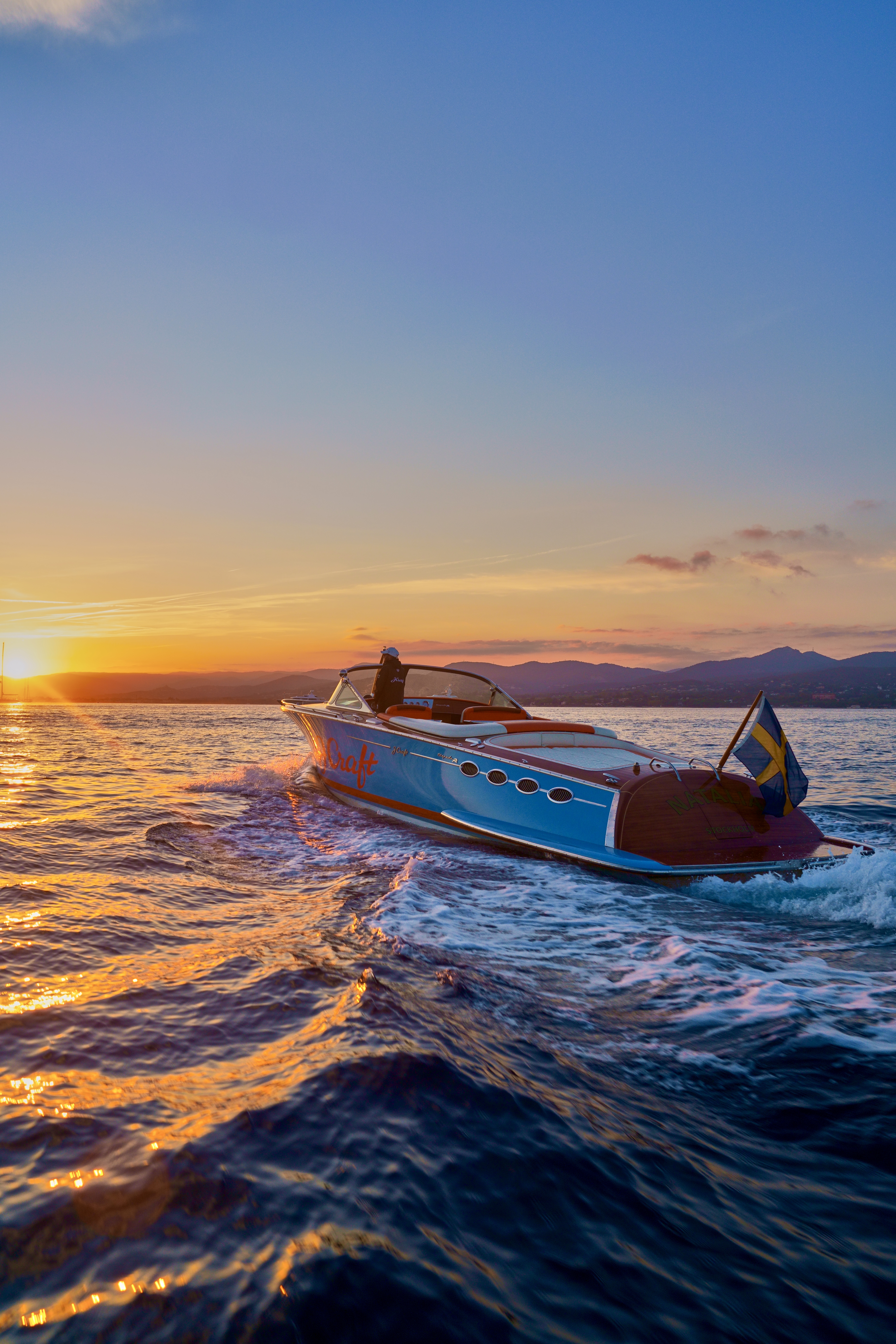
A complete modern technology platform, integrated invisibly into a hull that looks, from any dock in Saint-Tropez or Stockholm, like a piece of maritime history. None of it visible from the outside.
Published February 23, 2026
Updated July 2, 2026
Words by: J Craft

Jacques Sicotte goes out on the water the way other people take taxis. From May through October, he and his wife Linda leave the French Riviera in their J Craft Torpedo the way a sensible person avoids traffic. "From May to October we rarely use our car to go to Monaco or Saint-Tropez," he explains. "From home to Saint-Tropez is 50 minutes in Temptation. By car it's two hours and 50 minutes in the summer, even in a Ferrari." Sometimes he slips out after the school run. Sometimes he is simply in the mood for breakfast somewhere along the coast.
Sicotte is a nuclear engineer, a Ferrari Ambassador, and a collector of historically significant cars. He describes what the Torpedo produces at the helm like this: "I'm a skier and I love to do powder skiing. In a Torpedo, on a flat sea, 42 knots is like doing powder: making effortless tight turns, just leaning from one side to the other." He speaks of "going out on the perfect morning to 'powder ski' on the ocean."
He is not describing speed. He is describing what the Torpedo makes possible: a vessel in which every potential source of friction between owner and water has been quietly engineered away, and every source of pleasure has been equally amplified. No rolling at anchor. No pitching through chop. No anxiety in a crosswind, no second-guessing in the dark. That sensation does not happen by accident. It is the product of a complete modern technology platform, integrated invisibly into a hull that looks, from any dock in Saint-Tropez or Stockholm, like a piece of maritime history.
To the observer on the quayside, the Torpedo is a mahogany day cruiser from the early 1960s. To the person at the helm, it is something else entirely – a fully integrated, software-driven architecture built around Garmin and Volvo Penta's Glass Cockpit, with no single point of control – and no single point of failure. Intelligence is distributed across the helm, retractable displays, portable devices, and wearables. If one interface goes offline, others remain immediately available.
This is J Craft's governing doctrine: evolution, not revolution. The systems described below are present on the Torpedo not only because they remove the reasons a person might hesitate before going out, but because they deepen the experience of being out there. They begin beneath the waterline, where the first question for any boat is always the same: what happens when the sea moves?

Table of Contents
1. What Is a Boat Gyro Stabilizer? The Seakeeper Explained
2. Zipwake: The Boat Stabilizer That Controls Pitch
3. Volvo Penta IPS: Docking Alone in a Crosswind
4. Starlink for Boats: Hull-Integrated, Always Connected
5. Marine Night Vision Camera and Modular Radar: Situational Awareness at Sea
6. Garmin Skyhook: Dynamic Positioning to the Centimetre
7. Boat Water Maker and Lithium Power: Independence at Sea
8. Garmin Quatix and the Glass Cockpit: The Boat From Anywhere
9. Built Where Boats Were Survival Tools
10. The Governing Principle
1. What Is a Boat Gyro Stabilizer? The Seakeeper Explained
A boat stabilizer exists to solve a specific physical problem. A boat at rest in a swell does not stay still. It rolls: side to side, continuously, at the frequency of every wave passing beneath the hull. At anchor in a bay, this is the difference between lunch at ease and lunch that requires concentration. Underway in a cross-sea, it is the difference between arrival and exhaustion.
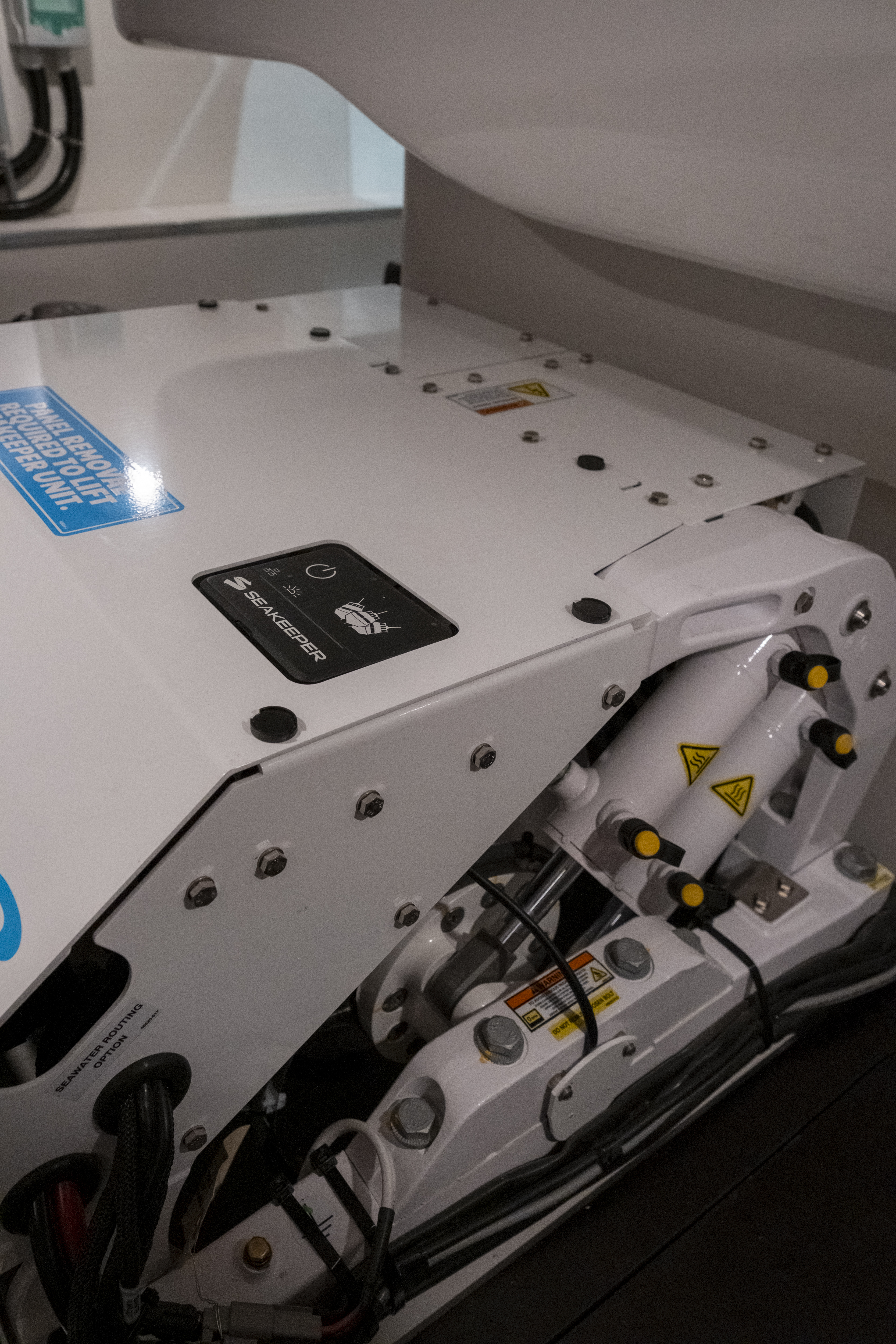
A boat gyro stabilizer addresses roll through angular momentum. Inside the Seakeeper unit, a precisely machined flywheel spins at high speed in a near-vacuum; the gyroscopic force this generates resists the rotational motion the sea is trying to impose on the hull. The result is a dramatically more stable platform – not steadier: stable. Guests stand at anchor without steadying themselves. A table is set without theatre. The quality of time aboard changes because the body is no longer working against the motion.
On the Torpedo, the Seakeeper is an optional specification, sealed and concealed entirely within the hull. From deck level, there is no trace of it. That invisibility is as deliberate as the Seakeeper's engineering: the Torpedo's silhouette must not be disturbed by the systems that make it liveable. The lines set by Björn Janson when the first hull was built on Gotland in 1999 remain unchanged. Everything added since has worked within that constraint.
This is the logic that governs everything else.
2. Zipwake: The Boat Stabilizer That Controls Pitch
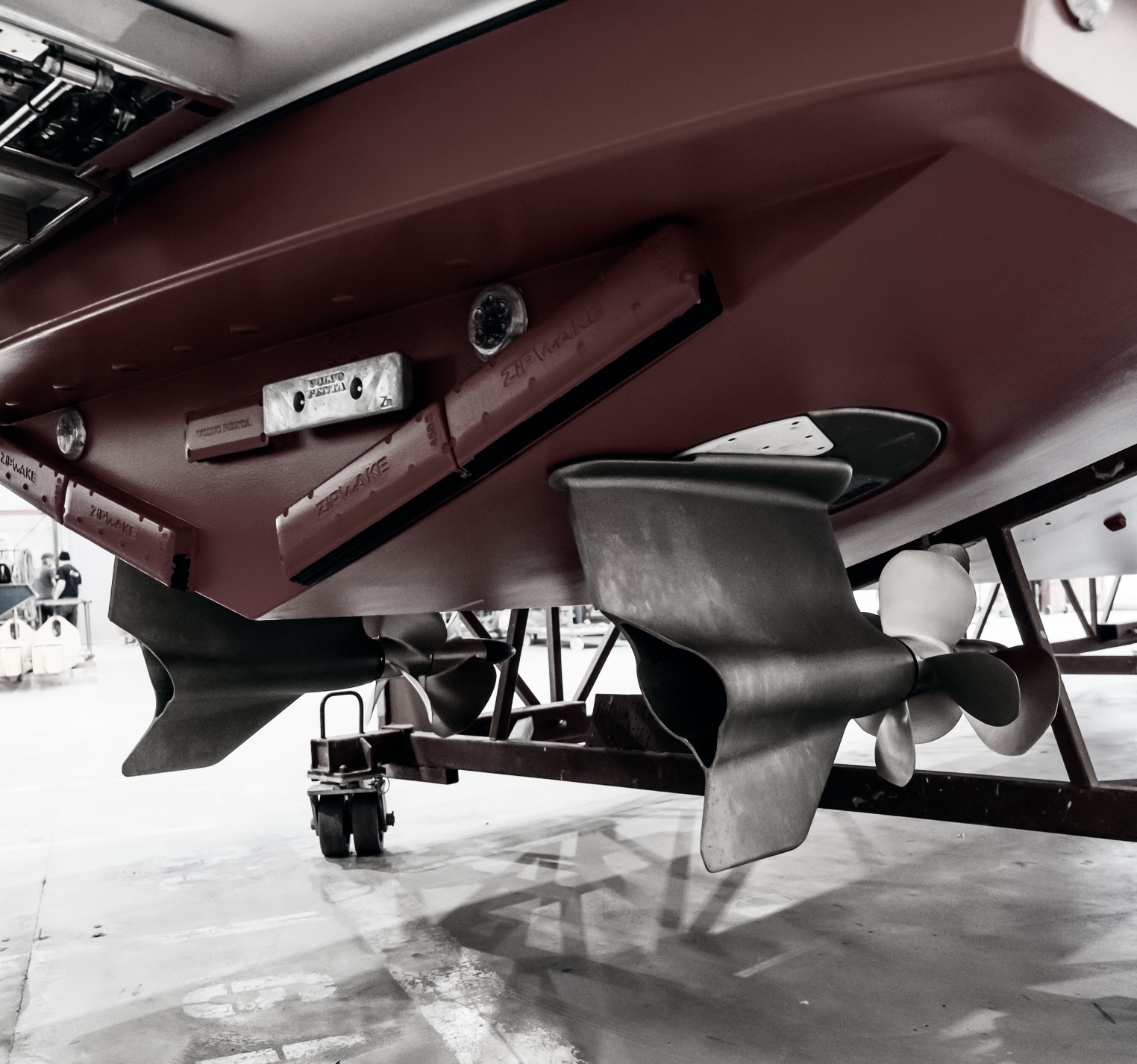
The second discomfort that boats traditionally impose is pitch: the bow lifting and dropping as speed builds, as waves pass, as weight shifts in the cockpit. Traditional trim tabs require the helmsman to monitor conditions and adjust by hand. The Zipwake system adjusts automatically.
Zipwake reads the boat's attitude continuously and corrects it in real time, keeping the bow level through the acceleration phase and in confused water. The transition to speed becomes composed rather than effortful. The bow does not rise to obscure the horizon. Visibility from the cockpit stays constant through the full speed range.
The Seakeeper removes the hesitation of anchoring in a swell. The Zipwake removes the hesitation of running in chop. Together, they transform the passage itself: no fatigue from motion, no compromise on pace. What remains is the pleasure of being at sea, unfiltered.
3. Volvo Penta IPS: Docking Alone in a Crosswind
The most revealing thing Sicotte says about his Torpedo is not about speed or design or the admiration it generates in port. It is this: "Because of the IPS drives I can dock it alone under any conditions, even in heavy winds. I don't need anyone to help out."
For a 42-foot (12.8 metre) hand-built boat representing 8,000 to 10,000 person-hours of craftsmanship, this is a significant statement. The Volvo Penta IPS system makes it possible. Each pod operates independently – one pushing while the other pulls simultaneously. The Torpedo pivots on its own axis, moves sideways, rotates in its own length: all from a single joystick. A 12.8-metre vessel manoeuvred into any berth, alone, without drama or assistance.
Volvo Penta IPS also delivers approximately 30% better fuel efficiency compared with conventional shaft drives, extending the Torpedo's range without compromise on pace. The joystick removes the hesitation at the dock. The efficiency removes the hesitation about distance.
Every new Torpedo owner receives a dedicated week of hands-on owner training from J Craft, designed to build full confidence with every system – from the joystick to the stabilisation to the electronic suite. The goal is complete owner-operation: no need for a professional crew, no hesitation, and full command from the first day the lines are cast off.

4. Starlink for Boats: Hull-Integrated, Always Connected
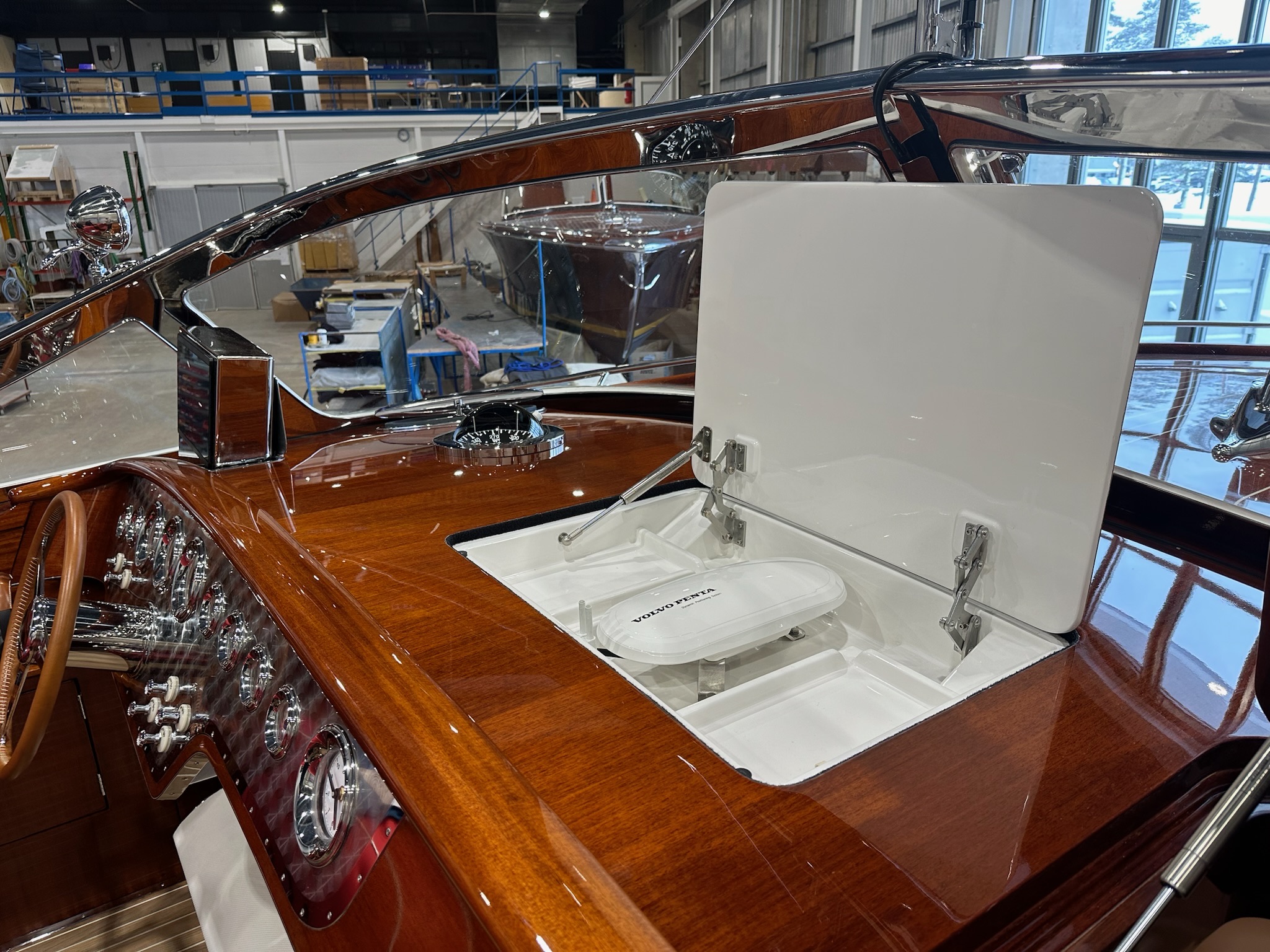
High-speed satellite connectivity is, on most boats, visually obvious: antennae on the superstructure, hardware on the deck. On the J Craft Torpedo, the Starlink antennae are integrated entirely into the hull structure. Nothing is visible from the dock. Nothing interrupts the silhouette.
The practical result is the same high-bandwidth connection available wherever the Torpedo operates – weather routing, communications, navigation overlays – without the visual compromise that hull-external installation would demand. A boat of the dolce vita era and satellite internet are not normally compatible. On the Torpedo, they coexist without evidence of either concession.
Connected from anywhere. No evidence of it from the outside.
5. Marine Night Vision Camera and Modular Radar: Situational Awareness at Sea
After dark on open water, what you cannot see is the primary risk. Floating debris, unlit vessels, harbour entrances in unfamiliar ports: these are the problems that genuine confidence after dark requires answering – and a single system is not the answer.
The J Craft Torpedo carries a FLIR night vision, thermal and infrared camera that is retractable and hull-integrated. When not deployed, it disappears entirely into the hull. When deployed, it extends effective visual range dramatically: darkness, fog, and reduced visibility conditions that would otherwise demand a reduction in speed become manageable, even navigable.
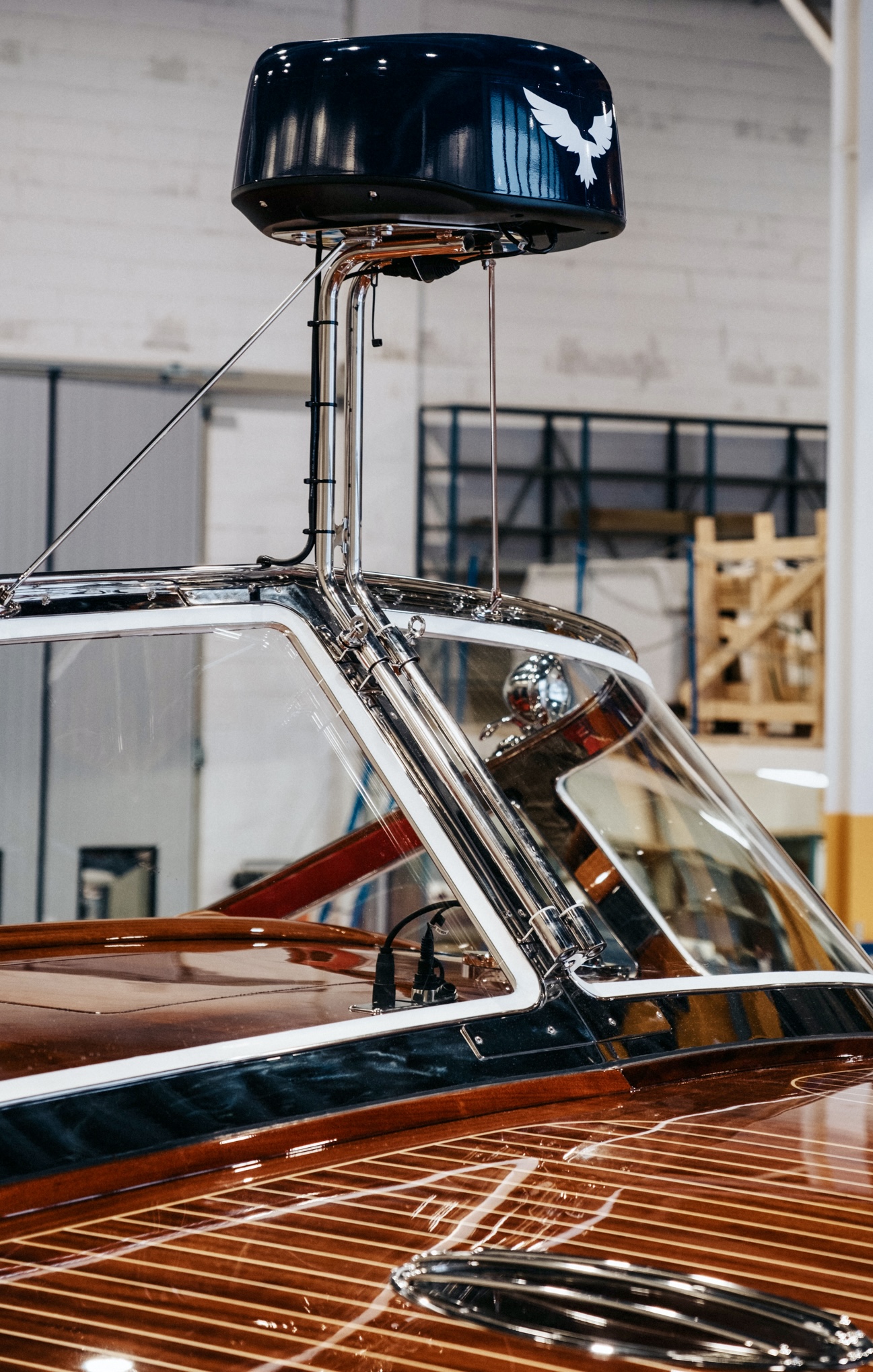
Alongside it, an integrated AIS system automatically identifies and tracks known vessels, while a modular MARPA radar independently monitors unknown objects, predicts their trajectories, and issues collision warnings. The distinction matters: familiar traffic is one kind of information; an unlit vessel on a converging course is another. The system makes that distinction instantly, reducing the cognitive load on the helm at speed or in congested waters.
The navigable day extends. The confidence to go further, and stay out later, grows.
6. Garmin Skyhook: Dynamic Positioning to the Centimetre
Classical anchoring is a skill. Reading holding ground, calculating scope, judging swing in changing wind: experienced mariners do these things well and novices do them approximately. In a tight harbour approach, or when holding position in crowded water while preparing lines and fenders, approximation carries consequence.
The J Craft Torpedo's Dynamic Positioning System, Garmin Skyhook, holds the boat's position to the nearest centimetre using satellite reference. Hull-integrated antennae, invisible from the exterior. The system requires no input beyond activation. The Torpedo holds precisely where it is placed, against wind or current, without drift – giving the single-handed owner the freedom to leave the helm, prepare the boat, and manoeuvre with precision in environments that would otherwise require a second pair of hands.
A controlled arrival in a busy marina becomes something other than a test of nerve.
7. Boat Water Maker and Lithium Power: Independence at Sea
The generator on a J Craft Torpedo is already whisper-quiet by design: a 12kW unit engineered for minimal acoustic intrusion. On most boats, this alone would represent a significant advance. The Torpedo goes further.
Extended lithium-ion battery banks provide up to ten hours of full-system power without the generator running at all. Climate control, audio, navigation, lighting: all of it available, in silence, for an entire day on the water. The generator starts when the owner chooses – not when the battery demands it.
The boat water maker (built-in desalination plant) extends independence further: fresh water produced from seawater as a standard option. The Torpedo can anchor in a remote cove with no return to a marina required. Time at sea, on its own terms.
This is evolution, not revolution, in its most practical expression. The boat accommodates longer, more autonomous use. None of the equipment that makes this possible is audible from deck level, or visible above it.
8. Garmin Quatix and the Glass Cockpit: The Boat From Anywhere
The Torpedo's cockpit is organised around a rose-polished steel dashboard and the original Nardi steering wheel – a design J Craft uses with special dispensation from Nardi itself, the same wheel found in the 1963 Ferrari 250 GTO. The quality of these surfaces is not decorative. They are the primary physical interface between owner and boat, and they are there because quality of contact matters.
Beyond the cockpit, the Torpedo's Garmin-based architecture and Volvo Penta Glass Cockpit ecosystem distribute command authority across every device on board. Engine management, radar, AIS traffic data, and full navigation are replicated across multiple wireless screens: a helm display, an iPad, a phone, the Garmin Quatix watch. Lighting, heating, air conditioning, and onboard systems can be adjusted from any of them – whether the owner is on deck, below, or not yet aboard. Routes, waypoints, and system instructions are sent from shore, from a phone, from a watch. By the time feet touch the deck, the Torpedo has been preparing for some time already: gyros spinning to readiness, the cabin cooled for a Monaco afternoon or heated for an early Baltic departure, navigation loaded and waiting. The boat does not need a moment to gather itself. Step aboard to a vessel already at readiness. Cast off and go.
There is no single point of control – and no single point of failure. The watch is not the dominant interface. The Nardi wheel is. But the ecosystem ensures that confidence is available from wherever the owner happens to be.

9. Built Where Boats Were Survival Tools
Understanding why all of this works as a coherent whole – rather than a collection of systems bolted to a classic hull – requires understanding where and by whom the Torpedo is built.
J Craft's shipyard is on Gotland, a Baltic Sea island that was once home to the Rus Vikings and later the Baltic Sea capital of the Hanseatic League. For centuries, boats here were not objects of leisure: they were instruments of trade, defence, and survival in one of the most demanding seas on earth. That legacy is not decorative. It is operational.
Many of J Craft's team come from naval and military backgrounds. The company's Chief Master Builder, Johan Hallén, is a former naval mine diver and navy captain – a profession defined above all by redundancy thinking, precision under pressure, and absolute trust in equipment. His perspective on how technology integrates into the Torpedo informs every engineering decision: not designed for the showroom – but for the moment when conditions deteriorate and the boat must perform without hesitation. He sets out his own philosophy in A Letter From Our Master Builder on Technological Innovation.
This mindset reaches into the materials. The Torpedo's glass is produced by the same specialists who manufacture glazing for Swedish naval vessels, engineered for impact resistance and offshore survivability. Structural components, including the windscreen frame, are not sourced generically: J Craft develops its own steel, tuned specifically for open-sea performance and fatigue resistance.
The hull is strong enough to be lifted from a single point, with crew onboard, on and off superyachts – a certification that demands exceptional torsional rigidity from bow to stern. Most day boats of this size never attempt it.
The technology was not appended to a beautiful hull. It was engineered into one, from the outset, by people for whom the idea of a boat failing at sea is not theoretical.

10. The Governing Principle
When Jacques Sicotte reaches for the phrase "powder skiing on the ocean," he is describing two things simultaneously: the absence of friction, and the presence of pure sensation. The boat gyro stabilizer eliminates roll. The Zipwake removes pitch. The IPS removes the anxiety of docking. Skyhook holds position in crowded water while the captain prepares lines. Starlink keeps the boat connected from anywhere. FLIR, AIS, and modular radar extend the navigable day into night. The battery banks silence the generator for ten hours. The water maker removes the dependency on a marina. The Glass Cockpit keeps every system available from wherever the owner is.
Remove the friction, and what remains is not neutral. What remains is amplified.
When Sicotte banks the Torpedo hard off the Côte d'Azur, passengers who have not been aboard before experience a brief moment of apprehension as the hull heels sharply into the turn. Then, immediately, that apprehension disappears. There is no lateral force throwing them sideways. The turn is composed, centred, easy on the body. Alfred Coyle, a former US Air Force F-15 pilot and Torpedo owner, explains what is happening: the boat banks like a well-trimmed aircraft, forces passing through the body downward and inward – not outward. You are held in your seat. "When they realise that it's perfectly safe," Sicotte says, "they say, 'Can you do it again?' That's the biggest thrill."
That behaviour is the combined product of hull geometry, Volvo Penta IPS, the Seakeeper's continuous roll authority, and Zipwake's real-time trim management: all working simultaneously, none of them asking for attention.
None of this is visible from the dock. From the outside, the Torpedo is a piece of maritime history – mahogany, steel, and the proportions of another era, built one at a time by a small team on a Swedish island in the Baltic. From the inside, it is the explanation of a sensation that Jacques Sicotte, for want of a better comparison, described in terms borrowed from a mountain.
To understand what that sensation feels like across a full passage, the February Journal piece tells that story in full: Invisible Confidence: How Technology Disappears on the Torpedo. To explore the Torpedo itself: The J Craft Torpedo. To understand how the boat is built: Craftsmanship.